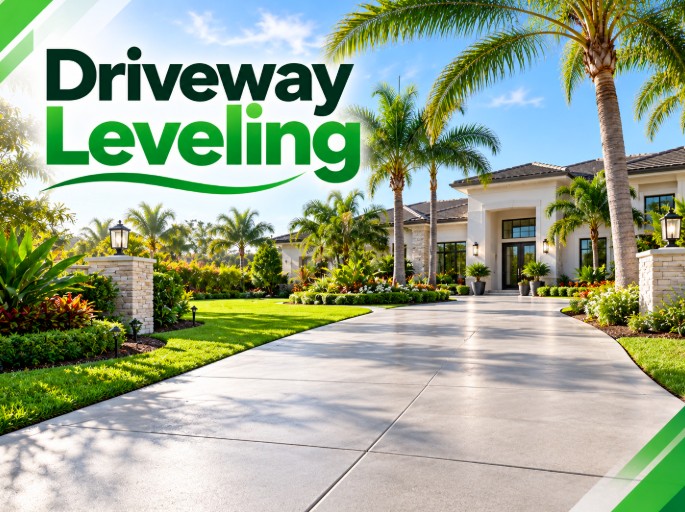
Driveway Leveling in Los Angeles
A driveway should provide a smooth, stable surface from the street to your garage or parking area. Over time, however, concrete slabs can settle at different rates. One section may sink while another remains in its original position, creating uneven joints, low areas, and uncomfortable transitions. Driveway leveling is designed to correct these changes without automatically replacing the entire driveway.
Professional Driveway Leveling for Uneven Concrete
Concrete driveways are heavy, and the soil beneath them plays an important role in keeping each slab supported. When soil becomes loose, washed out, compressed, or unevenly compacted, portions of the driveway may gradually move downward.
The result can include:
- Sunken driveway slabs
- Uneven concrete joints
- Low spots near the garage
- Changes in driveway slope
- Water collecting after rain
- Raised edges between neighboring sections
- Rough transitions from the sidewalk or street
- Concrete that rocks or feels unstable
A leveling service focuses on restoring the position of the affected slab while improving support underneath it.
Why Driveways Become Uneven
Driveway settlement rarely happens for only one reason. Soil movement may develop gradually over many years, while drainage problems can accelerate the process.
Common causes include soil consolidation beneath the concrete, erosion caused by water, inadequate base preparation, repeated vehicle loads, leaking irrigation, tree-root activity, and seasonal changes in the ground.
Concrete close to a downspout, landscaped area, or drainage path may experience different conditions than the rest of the driveway. That is why one slab can sink even when surrounding sections appear normal.
Leveling Instead of Full Replacement
A driveway with surface cracks does not necessarily need to be demolished. If the concrete remains reasonably strong and the primary issue is settlement, leveling may offer a more practical approach.
The objective is to lift or reposition the affected area and improve the support beneath the slab. This can help create a smoother driving and walking surface while reducing abrupt height differences.
Replacement may still be more appropriate when concrete is severely broken, extensively deteriorated, or structurally unsuitable for lifting. A professional inspection helps determine which approach makes sense for the condition of the driveway.
Driveway-to-Garage Transitions
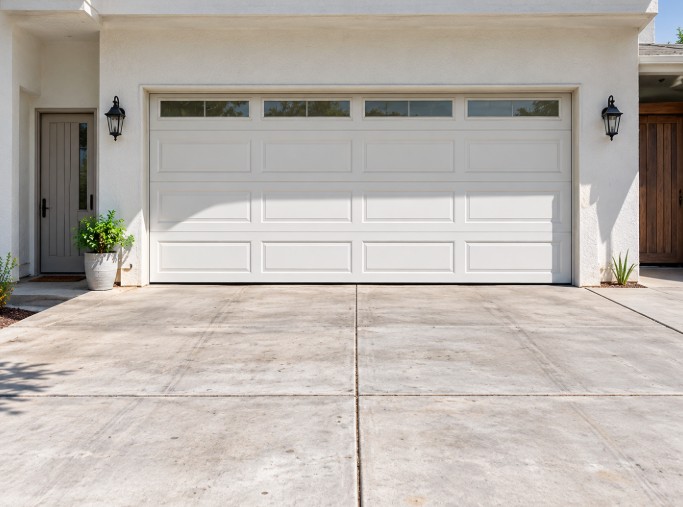
One of the most noticeable settlement problems occurs near the garage entrance. A driveway slab may sink below the garage floor, creating a bump every time a vehicle enters or leaves.
Correcting this area requires careful attention to elevation. The driveway should transition smoothly without creating an unwanted slope toward the garage.
Leveling may also help improve drainage in areas where settlement has changed the original direction of water flow.
Improving Safety and Appearance
Even small changes in concrete height can become noticeable in a frequently used driveway. Uneven joints may create walking hazards for residents, visitors, delivery workers, and anyone moving trash containers or equipment across the property.
Leveling helps create a more continuous surface while improving the overall appearance of the entrance to the property.
Driveway Leveling for Residential Properties
Driveway leveling can be useful for:
- Single-family homes
- Duplexes
- Rental properties
- Apartment parking areas
- Private residential roads
- Side-yard driveways
- Circular driveways
- Multi-car parking pads
Each layout creates different challenges, particularly when the concrete connects to several fixed elevations.
When to Schedule an Inspection
Consider having your driveway evaluated when you notice widening height differences, recurring puddles, a new bump at the garage, or slabs that continue to settle.
Addressing the underlying movement earlier may make it easier to preserve usable concrete before deterioration becomes more extensive.
A properly planned driveway leveling service can restore a smoother surface while preserving much of the concrete already in place.
Our Driveway Leveling Process
Every project varies, but a typical service begins with an evaluation of the affected slabs and surrounding conditions. Measurements may be taken to identify the amount of settlement and determine appropriate target elevations.
The concrete is then carefully adjusted using a leveling method suitable for the project. Material introduced beneath the slab can fill voids and help support the raised concrete.
The goal is controlled movement, not simply pushing the slab upward as far as possible.
Technicians must account for neighboring slabs, garage floors, sidewalks, curbs, drainage paths, and existing cracks.
- 1
Inspect and measure
We check every affected slab, measure how far it has settled and note drainage paths, cracks and nearby fixed points.
- 2
Set target elevations
Garage floor, sidewalk, curb and street heights guide the target, so the driveway transitions smoothly without sloping toward the garage.
- 3
Controlled lift
The slab is raised gradually while material fills the voids underneath and supports the concrete in its corrected position.
- 4
Seal and final check
Holes are patched, joints can be sealed, and we walk the driveway with you to confirm the finished transitions.
Driveway Leveling Cost in Los Angeles
Typical rate: $3 – $8 per sq. ft.
| Project | Size | Typical range |
|---|---|---|
| Single slab section | About 120 sq. ft. | $360 – $960 |
| Two-car driveway area | About 400 sq. ft. | $1,200 – $3,200 |
| Long or circular driveway | About 800 sq. ft. | $2,400 – $6,400 |
Prices are typical Los Angeles ranges. Your exact price is confirmed after a free on-site visit.
What affects the price
- How far the slabs have settled
- Number of sections that need lifting
- Condition of the concrete and existing cracks
- Garage, sidewalk and curb transitions
- Access for equipment
Driveway Leveling FAQs
Most driveway leveling in Los Angeles costs about $3 to $8 per square foot. A two-car driveway area of around 400 square feet often falls between $1,200 and $3,200. The final price depends on how far the slabs have sunk, how many sections need lifting, the condition of the concrete and access to the work area. We confirm the exact price after a free inspection.
In many cases the driveway can be used soon after the work is finished, but timing depends on the leveling method and the material placed beneath the slab. Your technician will tell you when it is safe to walk on the surface and when vehicles can return, so the newly supported concrete is not stressed too early.
Often, yes. When a driveway slab has sunk below the garage floor, leveling can raise it to create a smoother transition. We measure the garage floor, the slab and the drainage direction first, so the corrected driveway does not end up sending water back toward the garage.
For concrete that is still reasonably strong, leveling usually costs much less than tearing out and pouring a new driveway. It also avoids demolition, hauling and long curing times. If the slabs are badly broken or crumbling, replacement may be the better choice, and we will tell you honestly during the inspection.
Not necessarily. Many driveways with surface cracks are still good candidates for leveling. What matters is the overall strength of the slab, the width and location of the cracks and how much the concrete has moved. Cracks can also be sealed after leveling to help keep water out of the base.
Get a Free Driveway Leveling Estimate
Tell us about your concrete and we will schedule a free on-site inspection. You get a clear price before any work begins.
(213) 867-7935Mon – Sat: 7AM – 6PM